
Atmospheric Plasma Treatment
For surface activation & cleaning
Table of contents
- High-Precision Atmospheric Plasma Treatment for Surface Activation & Cleaning
- What is the science behind atmospheric plasma systems?
- Surface activation and material compatibility
- Seamless inline integration for Industry 4.0
- Technical support & process evaluation by Novel Technology Transfer
- Frequently asked questions
High-precision atmospheric plasma treatment for surface activation & cleaning
In high-tech manufacturing, achieving reliable bonding and ultra-clean surfaces is a critical factor for overall production yield. Atmospheric plasma treatment is a proven method for precise surface preparation without the need for a vacuum chamber. By increasing the surface energy of a substrate, this technology ensures that adhesives, coatings and inks adhere with maximum strength, even on low-energy polymers or metals.
Novel Technology Transfer offers atmospheric plasma solutions for demanding production environments, with a focus on semiconductor manufacturing and other sensitive applications. As an exclusive European representative of Surfx Technologies Novel Tec supports customers with suitable systems, technical consultation and service for advanced surface treatment processes.
These systems offer a sustainable, chemical-free alternative to traditional priming methods, allowing for a safer and more efficient production environment.
What is the science behind atmospheric plasma systems?
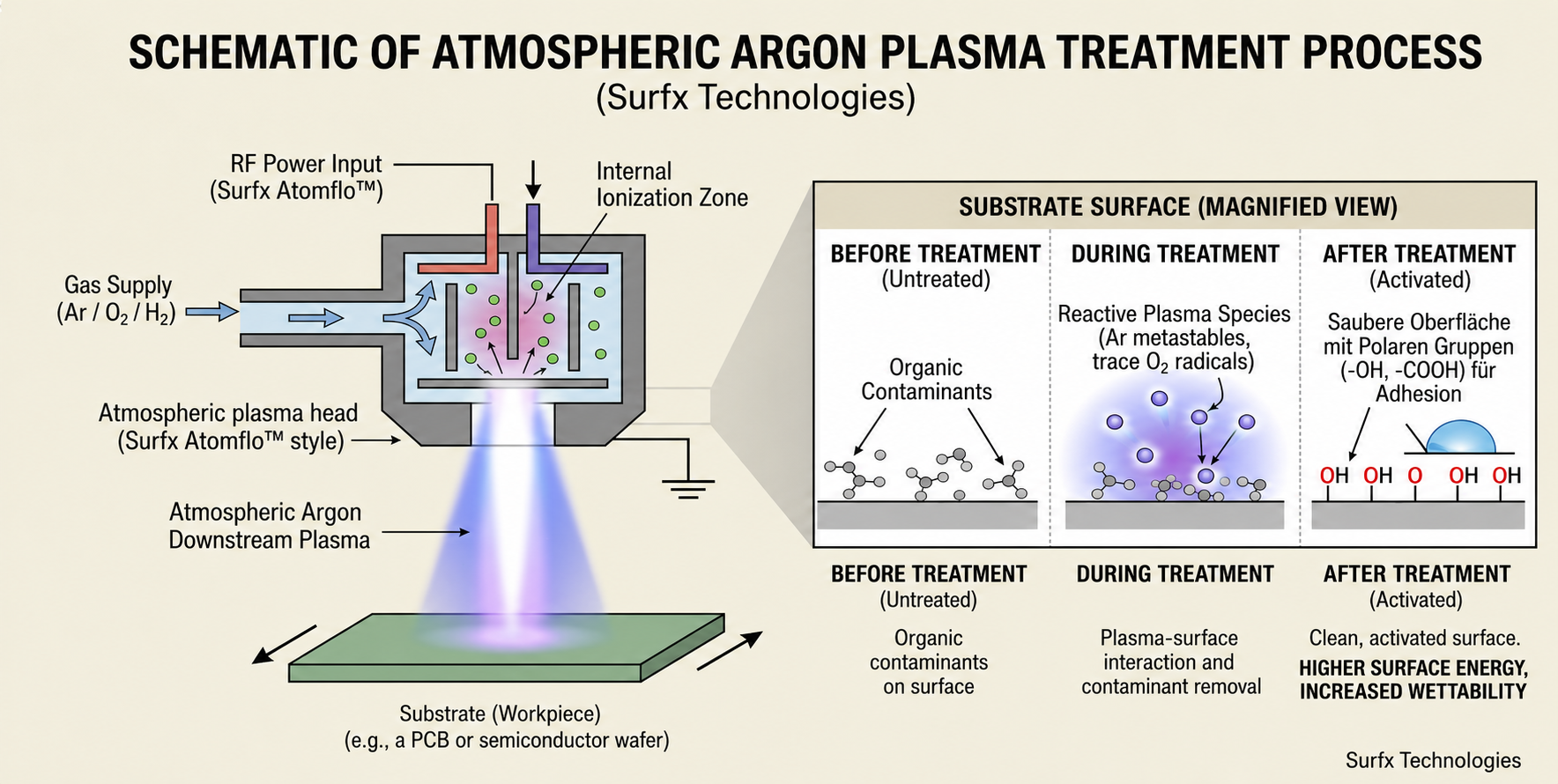
Understanding the fundamental differences in plasma chemistry is essential for selecting the right system. While many conventional systems rely on air-based discharge, we provide argon-based atmospheric plasma treatment systems for inline surface cleaning and activation. The atmospheric plasma cleaner directs ionized argon and process specific gases onto the material surface.
These systems are designed for controlled treatment of sensitive substrates and advanced manufacturing environments. The treatment removes organic contamination, supports the reduction of metal oxides in selected applications and creates surface conditions that improve wettability and bonding performance. Because the process runs at atmospheric pressure, it can be integrated into continuous production environments without vacuum based batch processing.
Surface activation and material compatibility
The primary goal of surface activation is to increase the SFE Surface Free Energy Level of a substrate to ensure it is ready to bond. This is achieved by breaking molecular bonds on the surface and replacing them with oxygen-containing functional groups. Engineers dealing with PEEK in medical devices or advanced composites in automotive engineering find that our atmospheric plasma systems provide the consistency required for high-strength interfaces.
The versatility of these atmospheric plasma solutions allows for the treatment of a wide array of materials. From traditional metals to engineered plastics, the process is fine-tuned to ensure that the bulk properties remain unchanged while the surface reaches its optimal energy state.
| Material Group | Compatibility | Typical Application |
|---|---|---|
| Polymers (PP, PE, PEEK) | Excellent | Medical catheters, automotive trim |
| Metals (Al, Cu, Stainless) | High | Wire bonding, electronics assembly |
| Ceramics | Good | Semiconductor packaging |
| Glass | Excellent | Optical coatings, display bonding |
For more details on process related use cases, please get in contact with us.
Seamless inline integration for Industry 4.0
One major advantage of modern atmospheric plasma cleaning is its compatibility with inline manufacturing concepts. Plasma sources can be integrated into automated production lines and adapted to specific throughput and handling requirements. This is especially relevant in semiconductor and electronics manufacturing, where repeatability, cleanliness and stable process control are critical.
Novel Tec supports customers with integration focused plasma solutions from Surfx Technologies for new and existing production environments. Depending on the application, systems can be configured for selective treatment, linear treatment or equipment level integration. For integration into automated manufacturing workflows, the Atomflo INT supports Ethernet/IP communication, process monitoring and data logging.
Benefits of inline integration
- Continuous inline processing: Treatment at atmospheric pressure eliminates vacuum chamber loading and pump cycles, supporting efficient manufacturing workflows.
- High repeatability: Automated treatment improves repeatability from part to part.
- Real-time monitoring: Digital process control enables monitoring of key parameters.
- Flexible integration: Different plasma head configurations support selective, linear and equipment-level integration.
Technical support & process evaluation by Novel Technology Transfer
Selecting the right atmospheric plasma solution requires a clear understanding of the material, contamination type and downstream process target. NTT supports customers from the initial consultation through installation and technical service. This includes identifying a suitable system configuration and evaluating how plasma treatment can be integrated into the required production process.
The goal is a reliable and application specific process for surface cleaning in semiconductor manufacturing and related high-tech sectors. For project specific support, please contact us directly: Contact us.
Frequently asked questions
Does atmospheric plasma treatment damage sensitive electronics?
Argon based plasma systems from Surfx are designed for sensitive substrates and are used in semiconductor and electronics manufacturing. Suitability depends on the component and the process setup.
How long does the surface activation effect last?
The duration of surface activation depends on the material and environmental conditions. For critical applications, bonding, coating or other downstream processes should follow plasma treatment as soon as possible to minimize recontamination.
Can atmospheric plasma replace chemical surface preparation?
In many applications, plasma can reduce additional chemical surface preparation steps. Whether it can fully replace primers or other chemicals depends on the material and the process target.
Is the system compatible with robotic integration?
Yes. Surfx atmospheric plasma sources can be integrated with industrial robots and automated manufacturing equipment. The appropriate plasma head and system configuration depend on the application and treatment requirements.
How do I know if the treatment was successful?
Typical verification methods include contact angle measurement, dyne level testing and application specific process validation such as adhesion or bonding tests.
CONTACT US
Novel Technology Transfer GmbH
Dorfstrasse 16
85235 Pfaffenhofen a.d. Glonn
Germany
Phone +49 (0)8134 55700-0
Fax +49 (0)8134 55700-10
Mail info@novel-tec.de


REQUEST A CALL